Chiang Mai in northern Thailand has been on the Southeast Asia travel circuit for decades, and searches for chiang mai thailand have grown 49 percent year on year. The question worth asking before booking is not whether it is popular, clearly it is, but what specifically makes it valuable for a student travelling on a short-format educational trip.
The answer is density. Chiang Mai offers more substantive learning experiences per day than almost any comparably sized city in the region. Not because it is trying to, but because the city has an unusually coherent cultural, ecological and philosophical identity that has been sustained over centuries and remains visible in everyday life.
The temples and what they offer
Chiang Mai is home to over 300 Buddhist temples. For students curious about religion, architecture, philosophy or urban history, the concentration alone is remarkable. Wat Phra That Doi Suthep, founded in 1383 and accessible via 306 naga staircase steps or a short funicular, sits 1,073 metres above the city and offers a view across the entire Chiang Mai valley that most visitors describe as genuinely clarifying. The temple is still in active use: a living institution, not a preserved relic.
Wat Chedi Luang Chiang Mai, in the heart of the old walled city, was once home to the Emerald Buddha and remains one of Northern Thailand’s most significant Buddhist sites. The evening monk chats held here are informal, unscripted and open to visitors: conversations about impermanence, intention and daily practice with monastery residents. These have no equivalent in any curriculum.
For students of design, history or religion, these chiang mai attractions are not just background scenery. The built environment of the old city is a legible record of how the Lanna Kingdom organised itself politically, spiritually and spatially over seven centuries. Some things to do in Chiang Mai, Thailand reward reading before you arrive and reflection long after you leave.
Craft, food and hands-on learning
About 15 kilometres east of the city, the workshop villages along San Kamphaeng Road sustain living production in traditional crafts: hand-painted paper umbrellas, silverwork, silk weaving on traditional looms, woodcarving, lacquerware. These are working businesses, not museum demonstrations. Students who spend time here are watching the economics and ethics of craft transmission in real time: how a skill survives contact with cheaper manufactured alternatives, what it costs to keep a tradition alive, who inherits it.
A cooking class in Chiang Mai run by a reputable local operator typically begins not in a kitchen but in a morning market, where the instructor explains the supply chain, the cultural logic and the regional flavour influences before any cooking begins. Northern Thai cuisine is shaped by trade routes connecting China, Myanmar and the rest of Southeast Asia. Khao Soi carries that history in its ingredients. For students of food, supply chain or cultural studies, this is field work, not leisure.
Chiang Mai is also one of the best cities in the region to experience Muay Thai, the national martial art, as a training discipline rather than a spectator sport. Evening classes are available across the city and offer a grounded, unromanticised introduction to a practice with deep roots in Thai culture.
The ecological dimension
Doi Inthanon National Park, 58 kilometres southwest of the city, is Thailand’s highest peak at 2,565 metres. The park contains cloud forest ecosystems found nowhere else in the country and records over 380 bird species. The twin royal pagodas near the summit, built in the 1980s to honour the King and Queen of Thailand, stand in gardens of considerable botanical detail. The drive up passes through Hmong hill tribe villages whose communities have farmed the mountain slopes for generations.
Closer to the city, the Chiang Mai sticky waterfall in Bua Tong is an unusual geological formation where mineral deposits in the water allow visitors to walk up the cascade itself. It is one of those things to see in Chiang Mai that manages to be both genuinely novel and ecologically interesting.
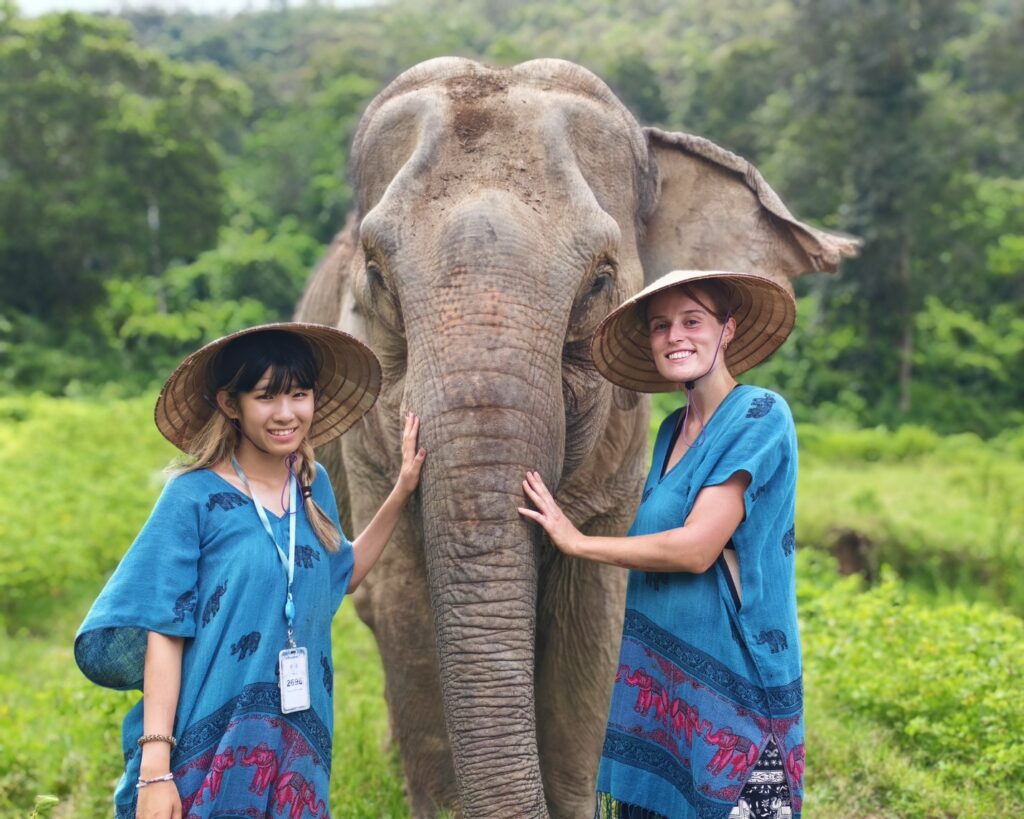
The elephant sanctuary options near Chiang Mai vary significantly in how they treat the animals in their care. We direct students specifically to a known partner who prioritise elephant welfare: no riding, no performance, genuine rehabilitation and conservation focus. The difference between a well-run and a poorly-run sanctuary is visible, and making that distinction teaches something about responsible travel that does not appear in any brochure.
Chiang Rai and Wat Rong Khun
An hour and a half north of Chiang Mai, Chiang Rai is worth including in any itinerary of more than three days. Wat Rong Khun, known internationally as the White Temple and searches for chiang rai thailand white temple have grown 235 percent year on year, is a contemporary Buddhist temple designed by Thai artist Chalermchai Kositpipat, who began construction in 1997 and has stated publicly that the project will not be complete in his lifetime.
The structure is white, inlaid with mirror fragments that catch the light at every angle. What distinguishes it from ordinary visual spectacle is that it is a serious artwork asking specific questions. The bridge into the main sanctuary passes over sculpted reaching hands, representing desire and the cycle of rebirth. The main hall contains murals that place traditional Buddhist iconography alongside contemporary references in a way that is deliberate and thought-provoking.
For students of art, architecture, religious studies or cultural theory, Wat Rong Khun is a case study in how a living artist engages with tradition and what it means to build something intended to outlast you. The Chiang Rai sightseeing circuit also includes the Black Museum, a compound of Lanna-style buildings housing the private collection of artist Thawan Duchanee, which is one of the most unusual and under visited cultural spaces in Northern Thailand.
Who gets the most from Chiang Mai
In our experience running educational tours and student trips through the city, students who arrive with some specific curiosity, rather than a generic interest in Southeast Asia, tend to get the most from Chiang Mai. The city rewards focus. It also rewards slowing down. The density of Chiang Mai attractions assure a week filled with activities that never repeat itself. The experiences that tend to stay are the ones approached with patience rather than pace and Chiang Mai is a great example.